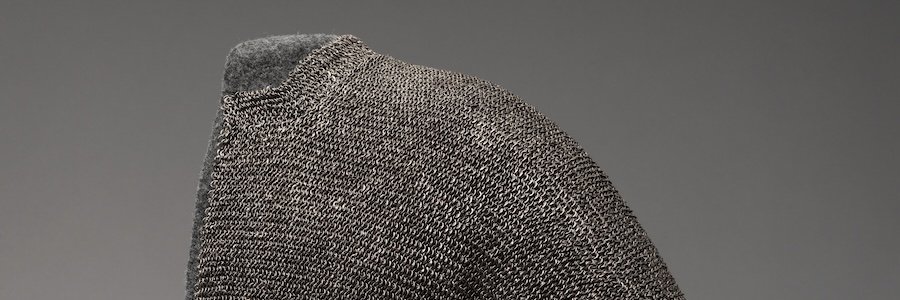
Pair of Voiders: Sew-on Maille
A Pair of Voiders
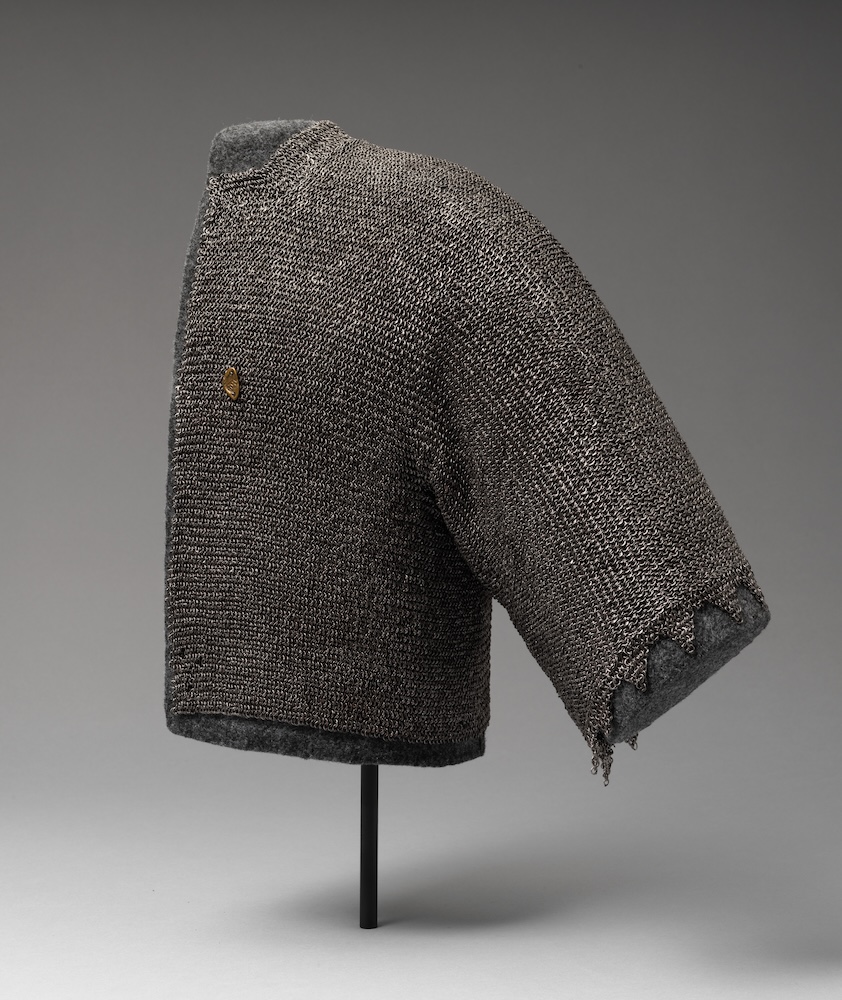
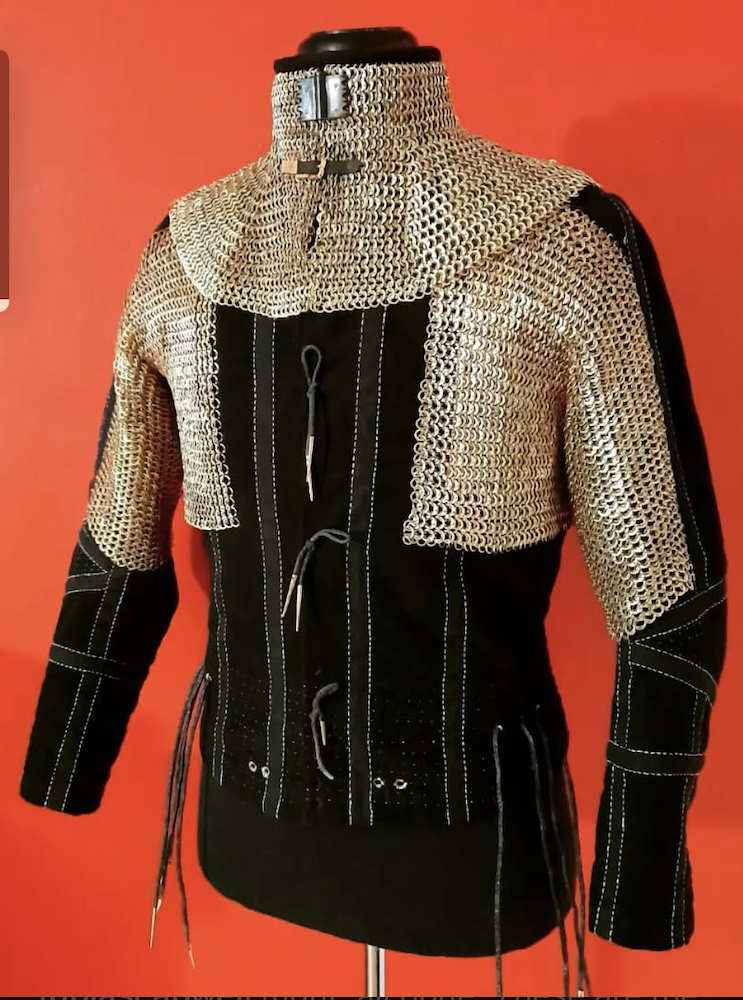
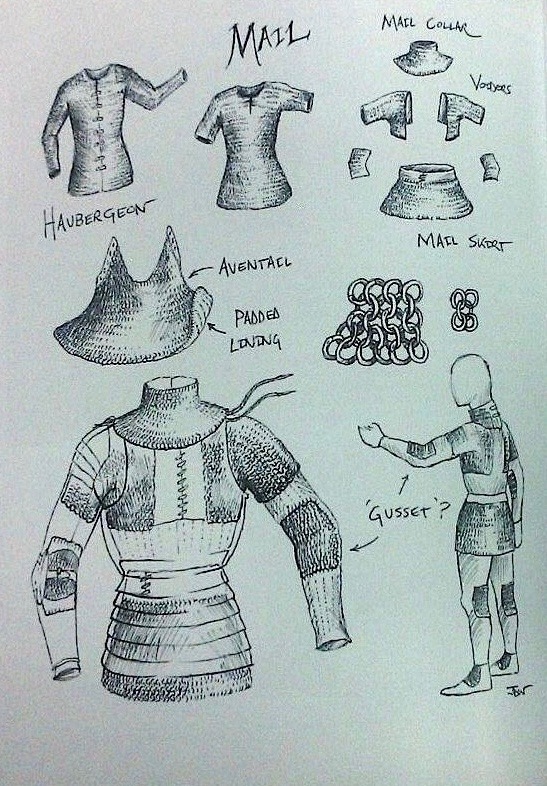
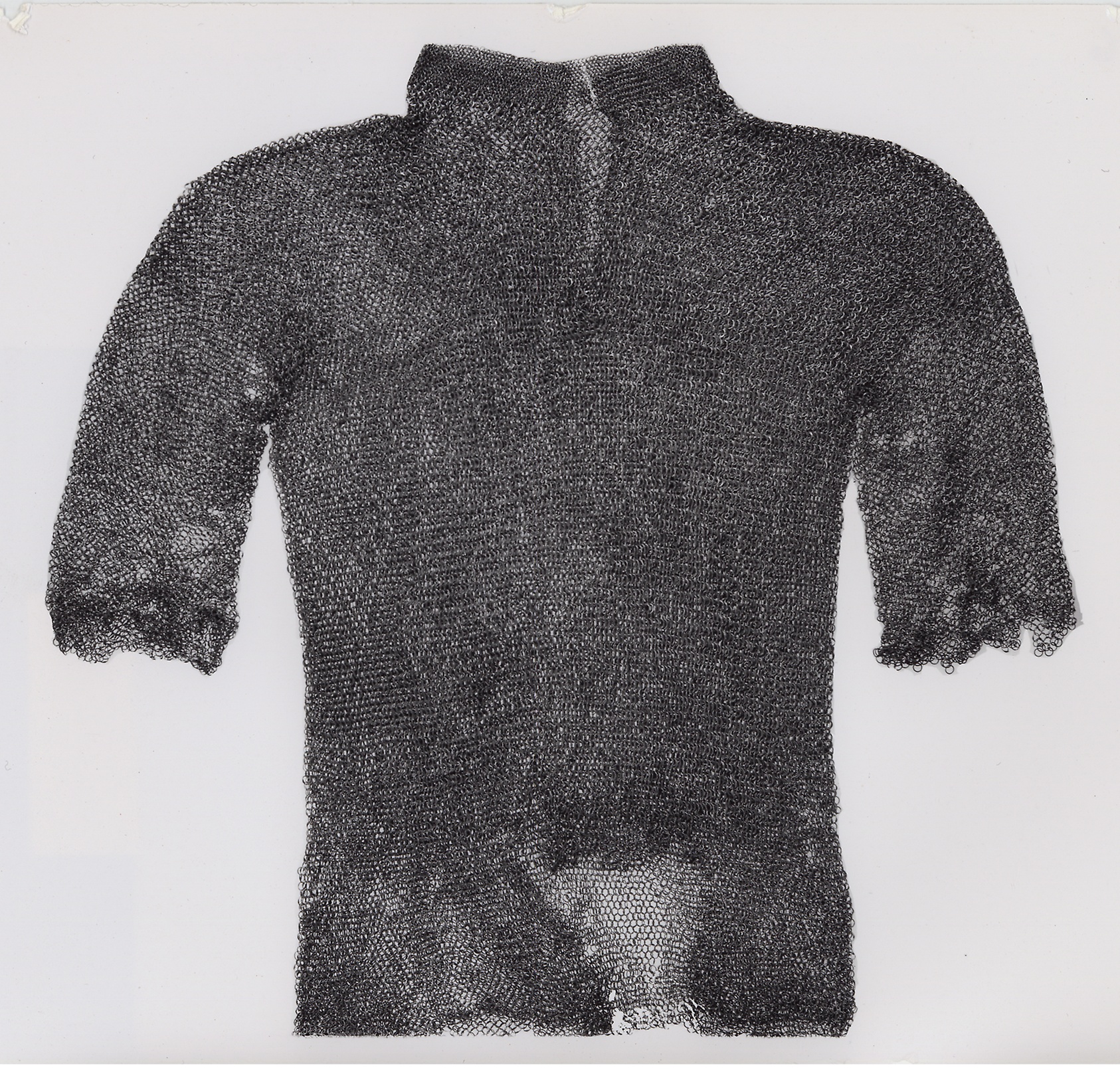
During the 14th century, steel plates were used to supplement maille armour. As armour evolved throughout the 15th century to become an almost impenetrable shell of steel plates, the need for an underlying maille shirt was reduced. For the man-at-arms, maille was really only needed to protect the gaps in plate armour, notably the neck, armpit, elbow, groin, etc. Hauburgeons (maille shirts) could be cut up into pieces to create sections, or gussets, of maille, which would considerably reduce the overall weight carried by a knight or man-at-arms.
Historical References
What kinds of armour could be found in a knight's personal armoury? Post-mortem inventories are a great resource as the document all of the wordly goods a person possessed at the time of their death. The following are selection taken from the Transcript of two Rols, containing an Inventory of Effects farmerly belonging to Sir John Fastolfe (pp. 41-2):
- Item, j Jakke of blakke lynen clothe stuffyd with mayle.
- Item, j Jakke of blake clothe lyned with canvas mayled.
- Item, xxilj Cappes stuffyd withe horne and sum withe mayle. (23 caps stuffed with either discs of antler or maille)
- Item, vj payre Glovys of mayle, of schepys skynne, and of doos. (6 pairs of maille gloves lined with sheep or doe skin)
- Item, ij Harburyones of I'milayne (Haubergeons de l'acier Milayne, or maille shirts of Milanese steel)
- Item, vi peces of mayle
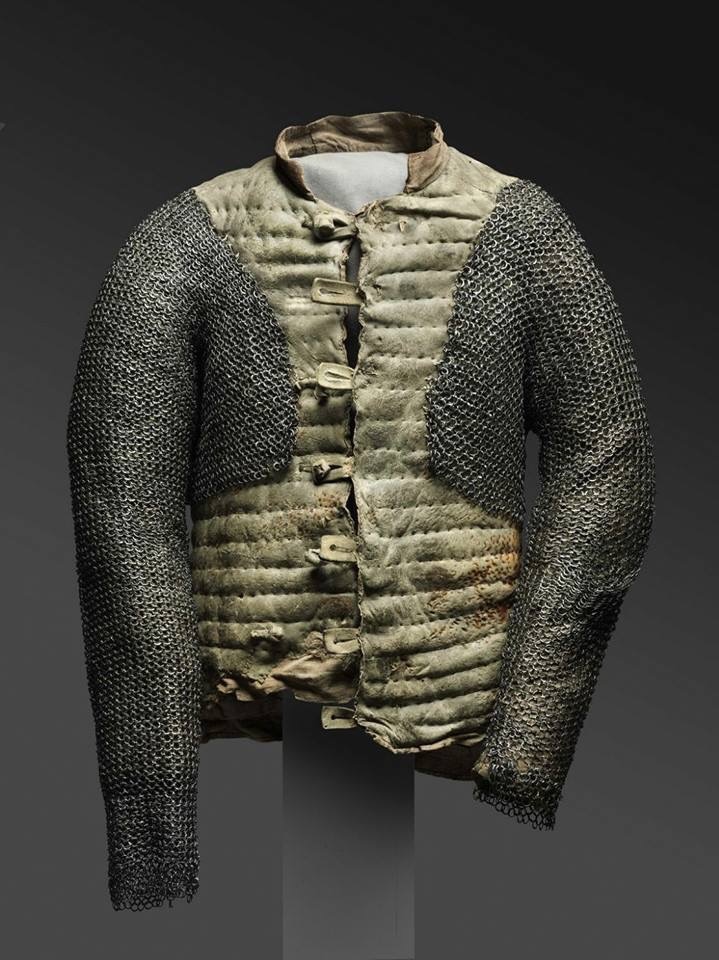
A Jack was a jacket made of up to 20 or more layers of primarily linen cloth. They were the most common form of armour worn by the average foot soldier. Black was the costliest color to dye cloth, so black linen was also a status symbol. As an added layer of protections, the above ones also included a layer (internal shirt) of maille. The pieces of maille could refer to gussets or sections of mail cut from a once-complete shirt.
In his book series Armour of the English Knight, Dr. Capwell cited Berkeley Castle Muniments of 1415 to state:
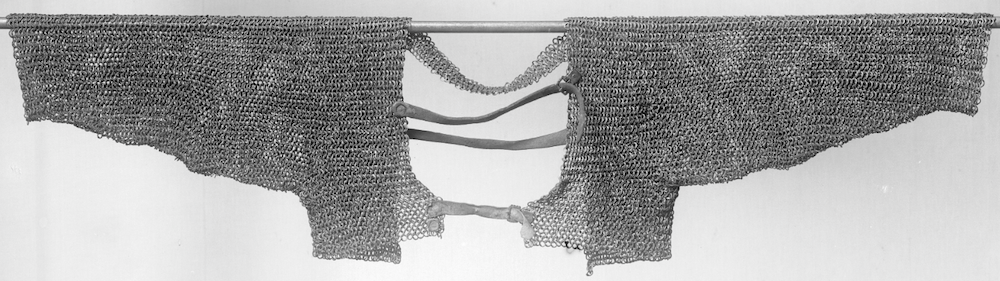
“The purchases of armour and accessories in 1415 by John de Mowbray, Duke of Norfolk and Earl Marshall of England, included ‘a pair of long voiders’ (j par’ voiders long’), ‘a pair of voiders for the vambrace’ (j par’ voiders ples vantbrace), ‘a pair of sleeves of jaserant mail’ (par’ bracc’ de mayle gesseraunt), ‘a pair of gussets of jaserant mail’ (uno par’ de Gussettes de mayle gesserant) and a ‘pair of gussets of mail of Milan’ (uno par’ de Gussett’ de mayle de milayne).”
Capwell suggests that long voiders may have been from armpit to just inside upper cannon, while a ‘pair of voiders for the vambrace’ may have been smaller panels to cover inner elbow. Jaserant (and its more English variant, gestron) was a term used for mail sewn between two layers of textile. The inner was often linen, while the outer was a more decorative fabric such as silk.
How were they attached?
The following tutorial is based upon a conversation with Dr. Tobias Capwell and a social media post written by Arne Koets, two of the leading authorities on knightly tournaments.
- Put on your armour and trace the edges of all the plates with chalk to show the portions of the arming doublet that are exposed.
- Carefully remove the armour without erasing your chalk markings
- Decide on how much overlap you can afford based upon the density of the mail (inner diameter) and the space you have inside each of the pieces (well-tailored armour fitted without maille will have limited free space inside the plates).
- Tailor the maille to extend to your predetermined overlap while still providing the necessary range of motion.
- Find the center-most link in your armpit and stitch that to the actual armpit of your arming doublet, usually best done (carefully) by another person while you are wearing it.
- The maille should be stitched on as high as possible in the armpit to provide best range of motion.
- ‘Compress' the maille around the corner to allow for some expansion when you lift your arm (the maille should hang tight, the links closely overlapped).
- The maille should cover all the gaps; this often involves a bit of a twist around the length of the arm depending on the style of armour worn.
Additional Considerations:
- Use waxed leather thread to stitch the maille to the doublet.
- If you decide to wash the doublet, cut the threads, leaving the stitches in the cloth. This will help you line up the mail when it is time to re-apply it.
- A band of maille across the shoulders behind the neck will reduce the amount of strain the voiders place on the arming doublet.
- Do not stitch the lower portion of the maille protecting the torso to the doublet. It will restrict your movement. However, it is important to connect the lower edges of the two torso flaps in order to keep them from coming out of the cuirass at the armpits. This connection can be with leathers or laces or a thin strip of maille.
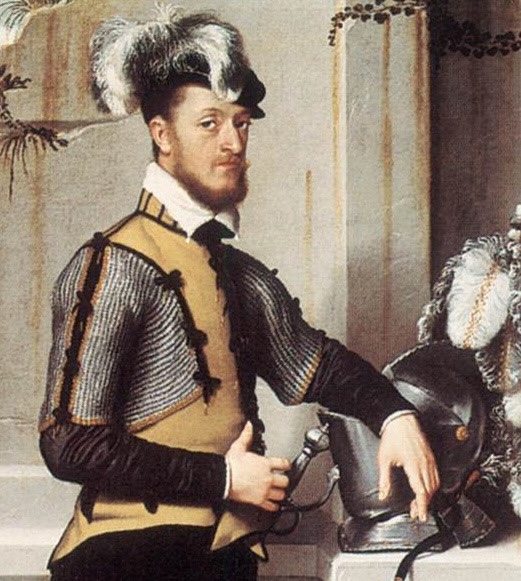
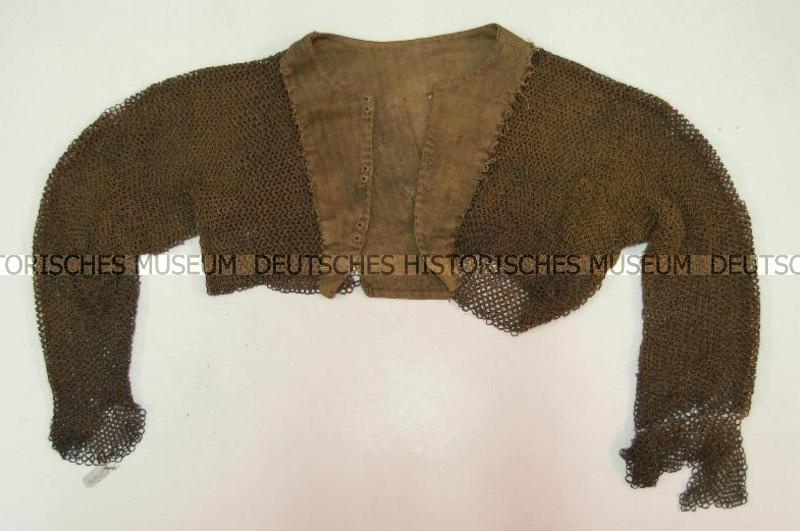
- Voiders have the advantage of more elbow movement in general over the pisanello (“bolero jacket”) of maille with long sleeves. They also use about 1/3 less maille than full sleeves, which considerable reduces the overall weight as well.
Further reading:
For a plausible example (reproduction) of an export harness for an English client, read Milanese Export 'Alla Inglese'.
For a commentary on how one member began tailoring their own maille garments see The Art of Maille-Making
For a brief explanation of how Milanese armourers mass-produced armour in various ways to appeal to the taste of clients across Europe, consider reading Regional Styles in Armour.
References:
Transcript of two Rols, containing an Inventory of Effects farmerly belonging to Sir John Fastolfe by Thomas Amyot, Esq. F.R.S., printed in ARCHAEOLOGIA Vol. XX1 (1826).
T.H. Turner (ed.), Manners and Household Expenses of England in the Thirteenth and Fifteenth Centuries (London: Roxburghe Club, 1841), p. 239.
Capwell, Tobias, Armour of the English Knight 1400-1450. (Thomas Del Mar, Ltd., 2015).